Compare
Contact Book vs Monica (Personal CRM): the honest comparison
Two products with the same goal, two different shapes. Here's where each one wins, where it doesn't, and how to pick.


At a glance
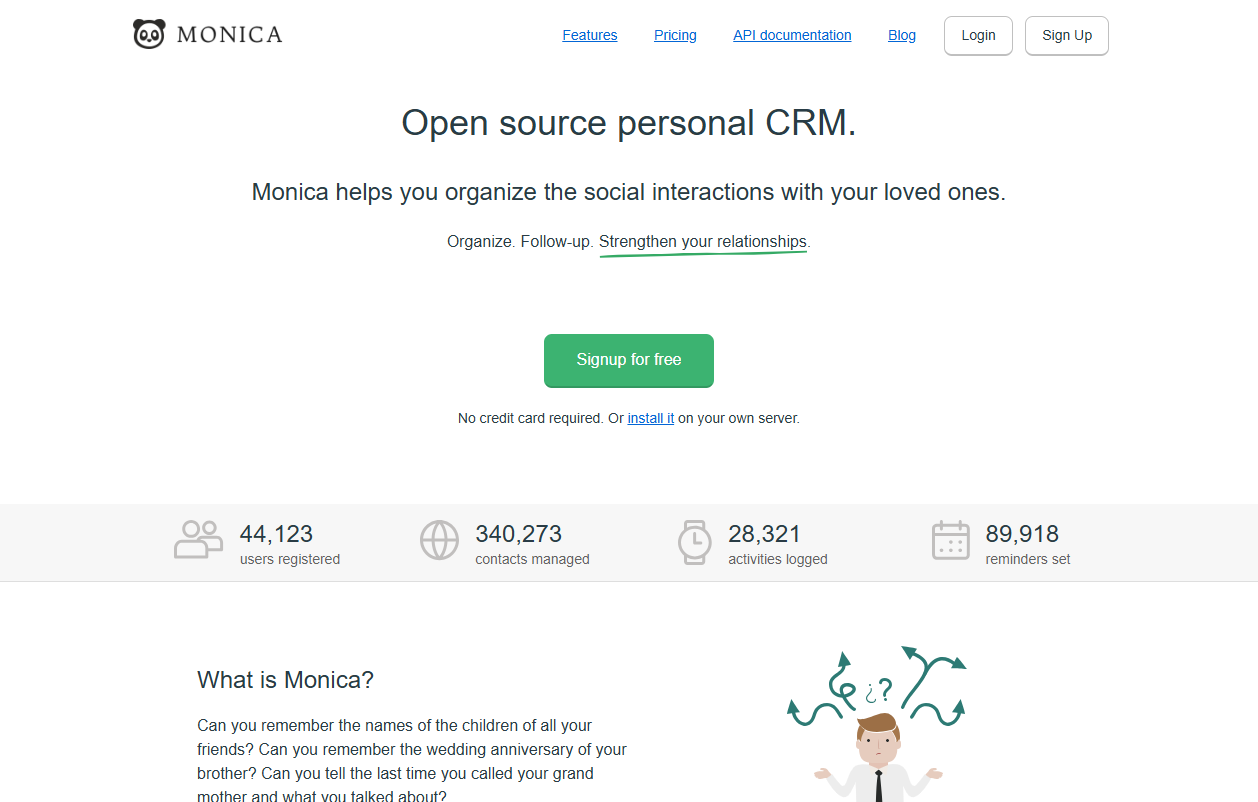
Monica is the elder statesman of the personal-CRM space - mature, open-source, actively maintained, and self-hostable. It is a genuinely good product and we recommend it without reservation to anyone who wants to run their own server. Contact Book is the answer to a narrower question: what if I want Monica's idea without running Monica's server? We're younger and lighter, with a sharper UI, live multi-tab updates, hosting in Germany, and a deliberately small surface. Self-host and tinker - pick Monica. Want a clean, fast, bilingual personal CRM you don't maintain, on a hosted plan from €1 a month - that's us. The short version: Monica without the server.
Contact Book vs Monica: feature comparison
When to pick which
Pick Contact Book when
Pick Monica when
Same goal, different shape
Both products want to give you a single calm place to keep the people in your life. Monica gets there with a comprehensive feature surface accumulated over years of community contribution. Contact Book gets there with a sharper, more opinionated subset and a fast UI on top.
The honest take: if you tested both and only had ten minutes per app, you'd probably feel us as faster and Monica as more configurable. Pick whichever feeling matters more.
Hosting + jurisdiction
Monica gives you two ways to run it: self-host it yourself anywhere, or use Monica's own hosted cloud. The self-host route means the data sits wherever you put it - full control. The hosted cloud, by contrast, doesn't publish a hosting location on its pricing page. Ours runs in Germany under German law and we say so plainly. For most users the EU GDPR baseline is the same either way; if you have a requirement that specifically points at Germany - or you just want the location stated, not guessed - that's a clear win for us. Otherwise, treat it as equivalent and pick on UX.
Hosted, without the self-hosting (the real cost math)
Monica's headline is "free and open-source", and on the self-host route it genuinely is - you pay only for a small server (roughly €5 a month). But free software isn't free time. Self-hosting Monica means you own the Docker stack, the database backups, the SSL renewals, and every version upgrade. Reviewers who've costed this out honestly land around €150-220 a year once you price your own maintenance hours - which is more than Monica's own hosted cloud (about €90 a year), and more than us.
That's the whole pitch in one line: Contact Book is for the person who likes Monica's idea but doesn't want a server in their life. If "Docker Compose" means nothing to you, or you've self-hosted before and are tired of being the on-call admin for your own address book, the hosted route is the right one - and we think we're the calmest version of it.
Migrating from Monica: what actually transfers
If you're already on Monica and weighing a move, the honest mechanics matter. Monica's contacts export cleanly as vCard (.vcf) - names, emails, phones, addresses, birthdays - and that file imports straight into Contact Book. Monica also offers a full JSON export (currently a preview feature) and an older SQL dump, but be aware: the JSON has no matching import on Monica's side, and the SQL route is being phased out and skips photos. So the realistic path is vCard for the contact graph, plus a short manual pass to carry over the handful of journal entries, gifts, or notes you actually want to keep.
None of this is a one-click miracle - no personal CRM ingests another's full data model verbatim, and we won't pretend otherwise. But the part that's painful to re-type, the contacts themselves, moves in minutes.
Common questions, answered
Is Monica still maintained? Yes - actively. It has a large open-source community, regular releases, and is a current, healthy project. We'd never tell you otherwise; this comparison is about shape, not about one product going stale.
Does Monica have a mobile app? Not a first-party native one - you use it in the browser. Contact Book is the same in spirit (web-first), but built mobile-first so the contact card loads fast on a phone. Does either read my email? No. Neither Monica nor Contact Book ingests your inbox - both are deliberate, manual-entry systems, which is the opposite design choice from Cloze.
Which should I actually pick? If you want to own the server, Monica. If you want the idea without the server, us. If you're not sure, our free tier lets you try the hosted experience before you decide.
Try Contact Book
Free plan, no credit card. We host in Germany. You can export and delete everything self-serve.
Written by
Julia Yukovich
Co-Founder + CEO
Julia is one of the Co-Founders. She handles design, development, product direction, and most of the support replies that arrive in the morning.
Read next
Contact Book vs Google Contacts: which one keeps relationships warm?
A directory vs a relationship log: where each one shines and where they don't.
Read
Contact Book vs Cloze: which one fits a solo professional?
Cloze ingests your inbox; we don't. That's the design choice.
Read
Best personal CRM for solopreneurs in 2026
Curated picks for one-person businesses that need a memory layer for clients + collaborators.
Read